Handwritten signatures are still widely used to confirm identity, authorize transactions and express agreement or intent. What has changed dramatically is how they are created, captured, processed and verified.
Business has moved across paper, branch, mobile, remote and electronic document workflows. Signatures have moved with it, from ink on paper to scanned and mobile images, static electronic captures and recorded writing trajectories.
Newer authentication methods have not replaced signatures, which remain built into financial, legal, government, healthcare and business processes. Verification technology has had to evolve, however, to keep up with how those signatures are now captured and used.
Signatures Now Arrive Through Many Channels
Traditional signature verification was built for a straightforward task: compare a signature image with a known authentic reference. Modern environments are rarely this simple.
Today, a signature might come in as ink on a scanned document, a mobile-captured image, an extracted signature snippet, a static image from a pen-enabled device, or a dynamic trajectory that preserves characteristics of the signing process such as speed, stroke information, pressure and timing.
Reference signatures may also come from different sources. An institution might have years of scanned paper signatures while new transactions arrive through digital channels. Meanwhile, electronically captured signatures may be stored as static images or as complete trajectories.
SignatureXpert.AI is designed for this mixed environment. It works with static signature images and dynamic trajectories, including cross-media scenarios where the signature in question and its references come from different media.
Verification is no longer limited to comparing similar images acquired under similar conditions. It increasingly means verifying the same signer across different documents, capture methods, image conditions and channels.
Why Verification Has Gotten Harder
No one signs their name exactly the same way every time. Even under similar conditions, a person’s signature varies naturally in shape, size, proportions, slant, spacing and other visible characteristics. Physical condition, writing position, available space and writing surface can add even more variation.
Electronic capture adds another layer. When a signature is captured as a trajectory, speed and acceleration, pen tilt, timing, pressure and other dynamic characteristics can all become part of the record, and these also vary naturally from one signing to another.
The capture process itself adds more variables. Scanning, mobile capture, electronic rendering, resolution, sampling and device characteristics can all affect what information is available for verification.
Fraud complicates the picture too. A skilled forger may imitate visible characteristics, while a fraudster may trace or reuse an authentic signature. In some cases, a signature that matches too closely should raise as much concern as one that differs.
The real question isn’t just whether two signatures look alike, but do the similarities and differences between signatures fit the genuine signer and the conditions of capture, or do they point to fraud?
The Document Matters
In production environments, signatures rarely arrive as clean writing on a white background. They often cross printed text, lines, boxes, security patterns, stamps or other handwriting, while the image itself may contain noise, compression, scanning artifacts or complex backgrounds.
That means reliable verification begins before comparison. The system first has to find the relevant signature and separate it from surrounding content, without removing or distorting details important for verification.
Fraud Has Changed Too
Traditional forgery is still a concern, but signature fraud now also includes tracing, copying an authentic signature from another document, reusing a captured signature image and substituting machine- or font-generated content. Each poses a different analytical problem. Depending on the method, the evidence of fraud may be a meaningful difference or a similarity too close to be natural.
SignatureXpert.AI: From Comparison to Signature Intelligence
SignatureXpert.AI is a new generation of ParaScript signature verification technology, built on decades of experience in handwriting recognition, image analysis, pattern recognition and automatic signature verification.
It brings signature location and preparation, multiple authentic references, static images and dynamic trajectories and complementary verification approaches into a common environment.
Rather than treating a signature as a fixed visual template, SignatureXpert.AI evaluates the available evidence of learned signing behavior, drawing from the final image, natural variation across a person’s authentic references and, when trajectory data is available, the signing process itself.
The result is what ParaScript calls signature intelligence: a measure of how strongly the available evidence supports consistency with the genuine signer.
A Multi-Engine Architecture for a Multi- Dimensional Problem
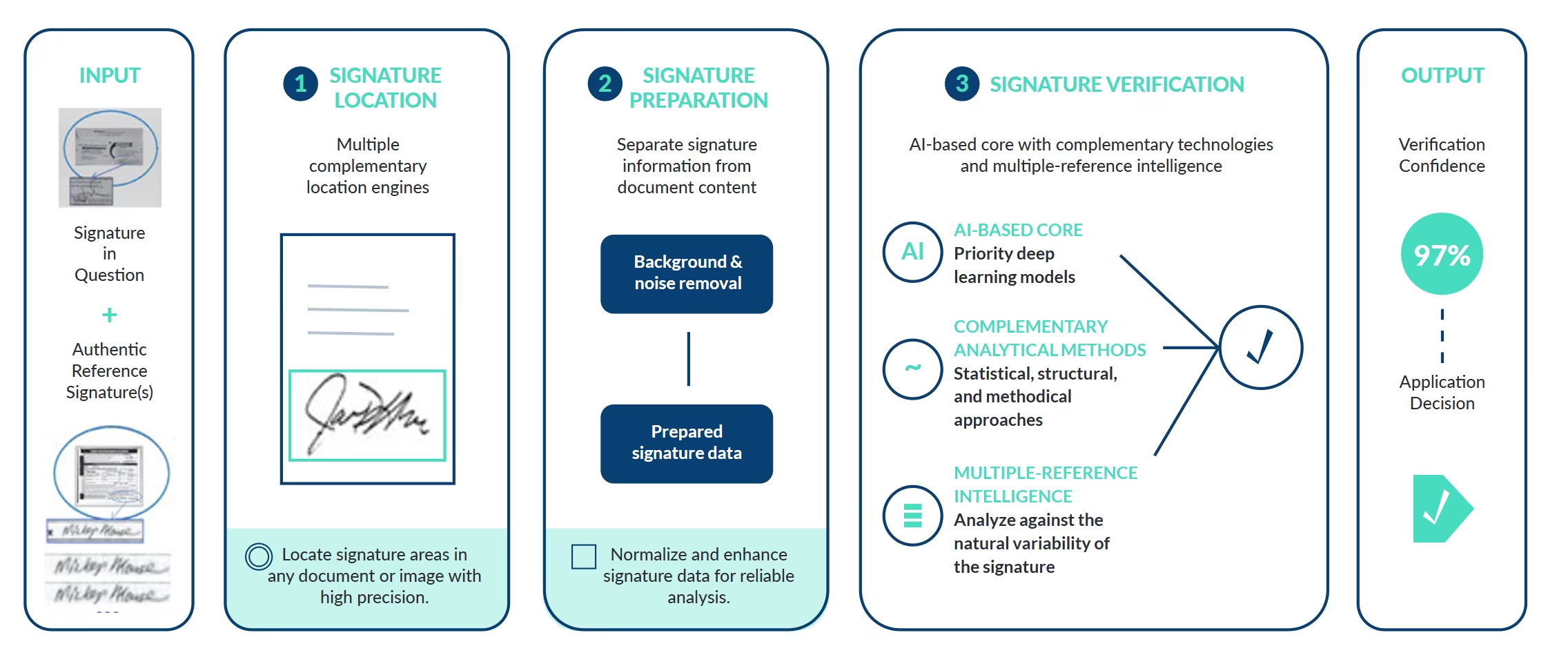
SignatureXpert.AI uses a multi-stage, multi-engine architecture in which specialized technologies locate and prepare signatures, analyze them from different perspectives and combine the resulting evidence.
At a high level, the architecture consists of three connected functional stages:
Signature Location
Signature Preparation
Signature Verification
The process produces a verification assessment and confidence value, which the host application applies according to its own business rules and risk requirements.
Signature Location: Finding the Right Signature
When given a complete document or fragment, SignatureXpert.AI first finds the relevant signature. This is more difficult than just detecting handwriting, because documents may also contain annotations, printed text, lines, security backgrounds or multiple signatures.
Signature location is a multi-engine process in its own right. Multiple complementary location algorithms allow the system to handle variation in document structure, signature style, position and image quality without relying on a single technique.
SignatureXpert.AI Multi-Engine Architecture Diagram
AI-powered core. Complementary technologies. Maximum accuracy and reliability.
Signature Preparation: Separating the Signature from the Document
Once a signature is found, it has to be isolated. Preparation reduces interference from lines, printed information, security patterns, noise and scanning artifacts while preserving the strokes that carry meaningful signature information.
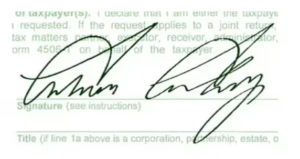
SignatureXpert.AI uses specialized image-analysis technologies, including AI-based approaches, to separate useful signature information from surrounding document content and prepare it for verification.
Signature Verification: Multiple Perspectives on the Same Problem
Next, multiple verification technologies evaluate the prepared signature, examining the available information from different perspectives.
At the core are AI and deep-learning technologies developed by ParaScript, including convolutional and recurrent neural networks trained specifically for signature analysis and verification.
The AI behind SignatureXpert.AI is proprietary to ParaScript and does not rely on Large Language Models (LLMs), generative AI or open-source AI systems. Verification takes place within the customer’s environment, without sending signature images, reference data or documents to external AI services.
In practical terms, SignatureXpert.AI brings the AI to the customer’s data rather than requiring the customer’s data to be brought to the AI. That means signature data never leaves the customer’s control.
Deep learning provides the core analytical capability, but no single method is best for every signature or verification scenario. SignatureXpert.AI complements its AI core with proprietary structural and geometrical analysis, fragmentation and signature-element analysis, matching techniques, decision-tree methods and mathematical approaches such as Fourier and Radon transforms.
12
fundamentally different verifiers
1M
images
100
neural
networks
20
years of improvements
30
data sets
∞
images and trajectories
These complementary technologies add independent forms of evidence that help resolve difficult or ambiguous cases and improve overall accuracy and robustness.
Understanding the Signer Through Multiple References
Because genuine signatures vary, any one reference only shows how a person signed on one occasion, under one set of conditions.
Multiple authentic references provide a richer picture of the signer, helping distinguish characteristics that remain relatively stable from those that vary naturally, such as proportions, spacing, scale, emphasis or individual movements.
There is an important distinction between having several references and using them collectively as information about the signer. A simpler system compares the signature in question with each reference separately and keeps the strongest match, so extra references only add more chances to find a close one.
Multiple-reference Verification
SignatureXpert.AI goes a step further, using information from across the whole reference set to build a broader representation of the genuine signer.
Reference quality still matters, and more references don’t automatically improve verification. They must be authentic, correctly associated with the signer and suitable for comparison.
The objective isn’t to accumulate as many signatures as possible, but to provide reliable authentic examples that meaningfully represent the signer.
One Verification Technology for Static and Dynamic Signatures
SignatureXpert.AI brings static and dynamic signature verification into a single product. Static images preserve the completed visual form, while dynamic trajectories can also preserve information about how the signature was produced.
The software can verify image against image, trajectory against trajectory and across media, when the signature in question and its references use different representations.
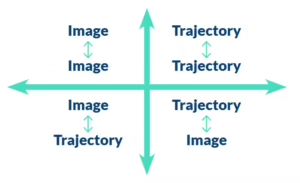
Cross-media verification matters because reference repositories and new transactions don’t always use the same capture technology. Years of scanned references can support signatures arriving through newer electronic channels, and electronic references can support scanned documents, without requiring a separate verification technology.
Beyond Forgery: Detecting New Forms of Signature Fraud
Signature forgery is still one of the fundamental challenges in signature verification. What has changed is the range of ways signatures can now be falsified, reproduced or misused.
Handwritten forgeries fall into three broad types: random, simple and skilled. Each step up reflects more access to the genuine signature and a more deliberate attempt to imitate it.
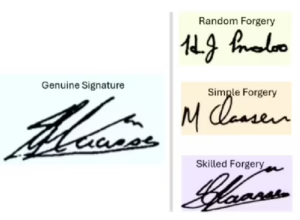
Random Forgery: No Attempt to Imitate the Genuine Signature
In a random forgery, the fraudster has no meaningful knowledge of the genuine signature and substitutes arbitrary writing or a different signature. The result usually differs substantially from the authentic references.
Simple or Blind Forgery: Knowing the Name, but Not the Signature
In a simple or blind forgery, the fraudster knows the person’s identity or name but not what their signature looks like. The result may spell the name correctly while still reflecting the fraudster’s own handwriting.
Skilled Forgery: Deliberately Imitating the Genuine Signature
A skilled forgery is a much more difficult problem.
In a skilled forgery, the fraudster has access to authentic examples and deliberately imitates them. The visual resemblance may be convincing, but subtle structural, geometrical or dynamic characteristics can still reveal inconsistencies.
Copy and Duplicate Fraud: When Similarity Becomes Suspicious
Random, simple and skilled forgery have one important characteristic in common: the fraudster produces a new signature. The level of imitation varies dramatically, but in each case someone attempts to sign on behalf of another person.
Copy fraud works differently and involves the fraudster obtaining and reusing an existing authentic signature. For example, they might copy it from another document or insert a stored signature image into a new one.
A copied signature can be extremely convincing, because it is a real instance of the genuine signature. This creates a paradox: a forgery may be suspicious because it differs too much, while a copied signature may be suspicious because it matches too closely.

SignatureXpert.AI includes dedicated copy and duplicate detection capabilities to address this type of fraud.
Duplicate detection takes more than pixel matching, though. Scanning can alter resolution, position, image quality, compression and other artifacts, so two images of the same physical signature may not be identical.
Reliable duplicate detection requires specialized analysis, and greater similarity cannot always be interpreted as stronger evidence of authenticity.
When the “Signature” Wasn’t Handwritten
Some signature-like content isn’t handwritten at all. A font or other machine-generated representation can look like a signature without being produced through a genuine signing process.
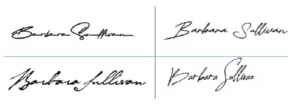
SignatureXpert.AI can differentiate wet handwritten signatures from font-based signatures, adding another type of evidence when the signature production method matters.
Additional Controls for Specific Fraud Scenarios
For banking applications, preauthorized draft detection helps distinguish preauthorized drafts from conventionally signed checks. Black and white signature lists can also incorporate known signature information into application-specific verification and fraud rules.
Confidence-Based Verification and Decisioning
SignatureXpert.AI expresses verification as a confidence value that reflects how strongly the signature in question corresponds to the available authentic references. The host application interprets that value according to its own risk tolerance and operating requirements.
From Confidence to Decision
Configurable thresholds translate the confidence value into workflow decisions: strong results may proceed automatically, low-confidence results may be treated as suspect and an intermediate range can be routed for additional verification or manual review.
Thresholds are application-specific and can be selected according to fraud risk, operational requirements and business objectives.
Balancing False Positives and False Negatives
Setting a threshold means balancing two types of error. A false positive flags a genuine signature as suspect, while a false negative accepts a fraudulent signature as genuine.
A more conservative policy can reduce missed fraud but increase false positives and manual review. A more permissive policy allows more straight-through processing while accepting greater risk of false negatives.
There right threshold varies by organization and the decision depends on fraud exposure, transaction characteristics, review capacity, operational cost and tolerance for each type of risk.
Signature Intelligence in the Broader Fraud-Prevention Ecosystem
Signature verification is one part of a broader fraud decision. SignatureXpert.AI can complement document analysis, transaction and account information, identity verification, business rules and other fraud indicators by contributing specialized evidence about the signature itself.
Designed for Real-World Deployment and Integration
Flexible Integration into Existing Applications and Workflows
SignatureXpert.AI is an embeddable software development toolkit for existing applications and automated processing environments. It can process complete documents or fragments, extracted signature images and dynamically captured trajectories.
The software returns verification results and confidence values to the host application for use in business rules, automated processing, fraud analysis or manual review.
Organizations retain control over when verification is performed, what reference information is supplied, how confidence values are interpreted and what actions follow the result. This flexibility lets SignatureXpert.AI serve as a specialized verification component or as one source of signature intelligence within a broader fraud-prevention architecture.
From Technology to Operational Value
Automatic verification delivers consistent analysis at scale, while letting human reviewers focus on cases that need additional judgment.
Visual verification has inherent limits. Even experienced operators can accept a convincing fraudulent signature or reject a genuine one that differ naturally from its references.
Understanding the Signer Through Multiple References
Because genuine signatures vary, any one reference only shows how a person signed on one occasion, under one set of conditions.
Multiple authentic references provide a richer picture of the signer, helping distinguish characteristics that remain relatively stable from those that vary naturally, such as proportions, spacing, scale, emphasis or individual movements.
There is an important distinction between having several references and using them collectively as information about the signer. A simpler system compares the signature in question with each reference separately and keeps the strongest match, so extra references only add more chances to find a close one.
When the Human Eye Gets It Wrong
The examples below show both kinds of mistake.
In ParaScript test examples, human operators accepted random forgeries despite substantial visual differences and, in other cases, rejected genuine signatures because natural variation appeared suspicious.
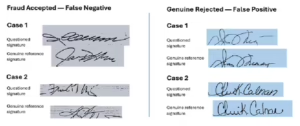
Automated Verification and Human Expertise: Complementary Strengths
Broader ParaScript testing showed the automated engine produced lower verification error than human visual review, with noticeable variation from one operator to the next. Human performance can be affected by expertise, fatigue, health, mood and working conditions. Automated analysis, on the other hand, applies the same process consistently.
The two approaches are complementary. SignatureXpert.AI can analyze large volumes consistently, while human reviewers can focus on uncertain or higher-risk cases and consider information beyond the signature when a case needs more investigation.
Confidence-based verification brings these strengths together: clear cases can be processed automatically according to chosen thresholds, while uncertain cases can be routed for additional analysis or manual review.
Signature Verification for a Changing Environment
Handwritten signatures still serve as evidence of identity, authorization and intent, but the environment around them has changed. Signatures now move across paper and digital channels, static images and dynamic capture, while fraud ranges from traditional forgery to copying, reuse and machine-generated signatures.
SignatureXpert.AI was developed for this environment. It combines proprietary AI and deep learning with complementary analytical technologies, multiple-reference intelligence, specialized fraud detection and support for static and dynamic verification. Together, they determine which similarities and differences matter.
Designed to work within existing applications and fraud-prevention workflows, SignatureXpert.AI provides confidence-based signature evidence consistently and at scale, supporting automation where evidence is strong and focused human review where additional judgment is needed.